
What makes a cat a cat?
Everyone knows what a cat is. Or at least, they think they do. But beyond the ears, eyes, size, claws, and whiskers, there are the cat’s BEHAVIORS.
DOMESTIC Cat
The cat is a domesticated species. This means it is better adapted to living and reproducing near humans than wild species. This process unfolded over thousands of years.
Unlike dogs, we never started hunting with our cats. It was the transition from nomadic to sedentary lifestyles that made all the difference: we began cultivating the land and creating grain stores. Grain means… mice! And that’s when the less timid cats began to stay close to humans. The abundance of mice near the grain stores became a very good reason to seek human proximity.
Over time, natural selection ensured that the cats most comfortable around humans proliferated, and the species slowly became domesticated.
Are there still “wild” cats?
Yes! The ancestors of the domestic cat belong to a class called Felis sylvestris. Their direct ancestor is Felis Sylvestris lybica. These wild cats still exist today, as do other species of Felis sylvestris.
These wild cat species resemble domestic cats, but they are distinct species. They should not be confused with domestic cats. Can you see the difference in these photos?
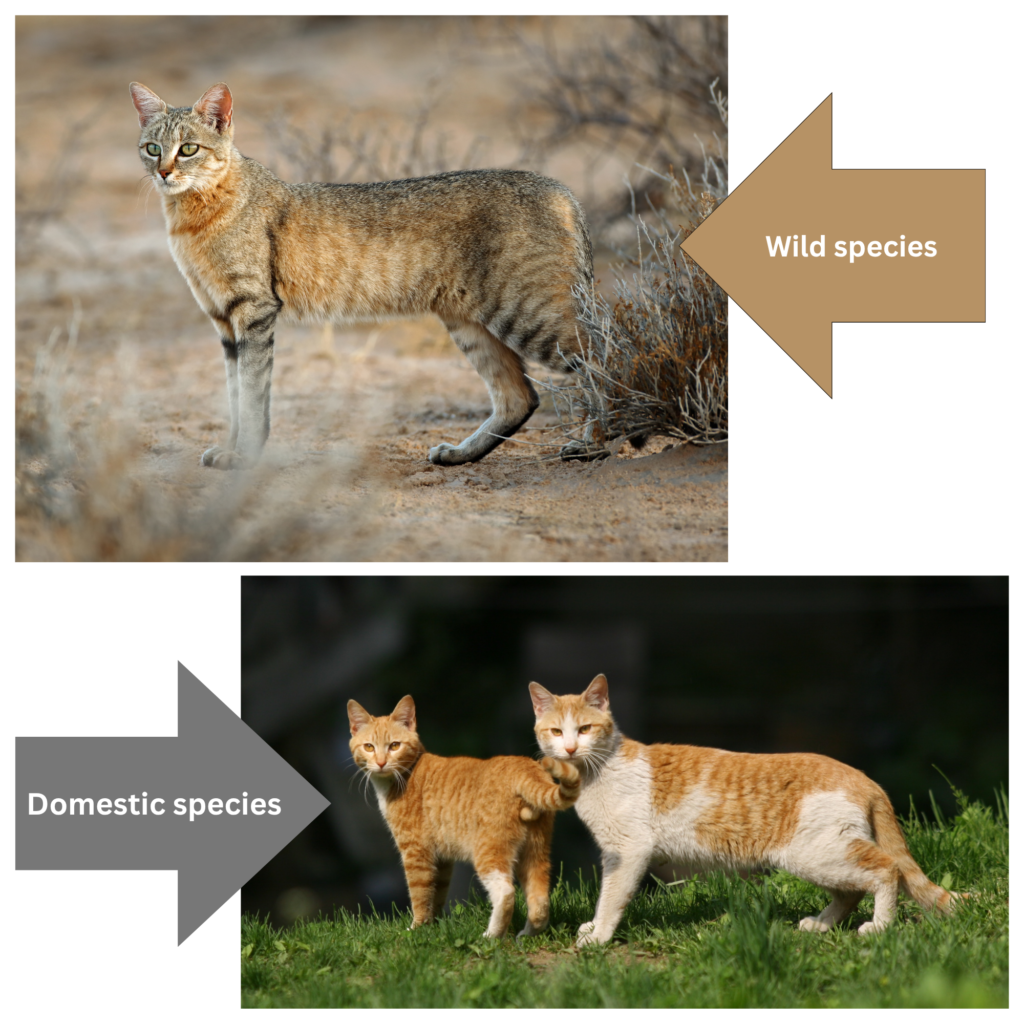
Feral cats (domestic cats that do not approach humans) should not be confused with wild cats (distinct and wild species).
Does domestication erase the qualities of the wild cat?
No. Domestic cats are not blank slates or robots. They retain some of the behaviors of their ancestors and have behavioral needs specific to their species.
Unlike dogs, in which different breeds have been selected to break the predation sequence (pointers point but don’t tear the prey apart, for example), cats retain their ability to meet their nutritional needs through hunting. Cats can, on average, survive better on their own in the wild than dogs.
Cat Species-Typical Behaviors
When we think of cats, we think of a small mammal that climbs, balances on the narrow tops of fences, scratches surfaces, and hunts. These are all typical behaviors of the species. However, there is much more to them than just the behaviors we find cute.
The way a species eats, drinks, defecates, and sleeps is typical to its species.
For example, we know that a cat’s body functions in a way that it needs small meals regularly throughout the day. Cats don’t just eat two large meals a day. They feed on mice and other small animals that aren’t very high in calories. Consequently, cats must constantly be on the lookout for an opportunity to hunt. Otherwise, if they waited until they were hungry, they would risk getting sick. That’s why they’re always ready to play! It’s like hunting.
Why is this important? Because many behavioral problems are caused or exacerbated by a cat’s inability to express thier typical behaviors.
Think of it like you think of food and water: cats have basic needs, but they also have BEHAVIORAL needs. If they can’t properly satisfy both, they won’t be well.
In a series of videos about species-specific behaviors, I explore the following topics:
Introduction to Species-Typical Behaviors
Eating
Drinking
Evident Cat Behaviors
Less Evident Cat Behaviors
A good understanding of the typical behaviors of each species in your home will allow you:
- To meet their needs
- To have happy and fulfilled animals
- To avoid behavioral problems stemming from unmet needs
- To avoid medical problems arising from or exacerbated by a lack of behavioral diversity
When should you worry about your cat?
If your cat is not doing a behavior that is generally popular among its peers, it does not necessarily mean that something is wrong, but it is a small red flag that tells us that there is something to check.
For example, if your cat never rubs themselves against objects or other living beings, the following questions can be asked:
- Are they in pain, so they avoid cuddling?
- Are they uncomfortable around the other people in the house and so they spend their time avoiding all contact?
- Do they have a history of being picked up every time they interact with a human, a reaction they hate, and have therefore decided to stop cuddling?
It is important to understand why a behavior does not occur, as it could be an indication of a problematic living environment or a medical problem.
Let’s not forget that we keep our cats captive, like in zoos. It is our duty to ensure their needs are met.
In this video, I explore the issue of red flags in more detail.
How do breeds of domestic cats influence species-typical behaviors?
Unfortunately, cat breeds are not designed to promote the well-being of individuals.
- Brachycephalic breeds, which have flat faces (Persian, Himalayan, Scottish Fold, Exotic Shorthair, etc.), have difficulty breathing, eating, and communicating effectively with other cats.1
- Breeds with elongated profiles are more difficult to read when they are in pain (Siamese, Balinese, Cornish Rex, Abyssinian, Oriental Shorthair, etc.).2
- Breeds with flat ears have a condition that makes joint pain much more likely to appear early in their lives and affects their ability to communicate with other cats (Scottish Fold).3
- Breeds with short legs have difficulty perching and navigating the world like other cats (Munchkin).
- Long-haired breeds have difficulty grooming themselves properly and quickly develop mats of fur that can even cause sores (Maine Coon, Norwegian Forest Cat, Ragdoll, etc.).
- Hairless breeds are prone to getting cold easily (Sphynx, etc.).
- Breeds in general are more susceptible to various diseases.4
The behavior of purebred cats is negatively affected by physical discomfort, physical limitations, and obstacles to effective communication between cats.
A cat that spends all its time lying down is an indication of a problem, a sign that the cat is not well. A healthy cat exhibits a wide range of behaviors. When a cat is unwell, however, their behaviors diminish significantly.
Choosing a cat because it has an appealing look, when it comes at the expense of their health and well-being throughout their life, is not an act of love or empathy. Buying a purebred cat encourages the breeding of cats that suffer BECAUSE OF HUMAN AESTHETIC DESIRES.
iCatcare also discourages the spread of cat breeds.5
Cat breeds are consumer products that people buy to “look the part,” to “have something special,” to be able to say they bought it, not out of genuine concern for the animal’s well-being. The cat breeding industry wouldn’t exist if we stopped buying cats from it. I encourage you to adopt your next cat or kitten from a shelter, not a breeder.
And what about hybrid cat breeds?
While cats are a DOMESTICATED species, and therefore better suited to living with us, some people breed cats for consumption by crossing them with wild species.
- Bengal
- Bristol
- Cheeoth
- Chausie
- Caracat
- Jaguarundi Curl
They are all hybrid races. They have no place in human society.
- These practices involve removing wild cats from their natural habitat and keeping them in captivity, in conditions that do not meet their natural needs. Some of these species are vulnerable due to their small population size. Removing individuals only exacerbates the problem of wild extinction.
- Domestic cats do not normally live with wild cats. For reproduction, they must be together, and this sometimes results in the domestic cat being attacked and killed by the wild cat.
- The size difference between the species is sometimes significant, as are the gestation periods, with the implications that this entails.
- The behaviors of wild cats are less well-suited to life in captivity with humans. Breeders knowingly put hybrid cats on the market that fail to adapt well to life in human society. People abandon them and get rid of them.
- In some cases, these cats are large and pose a danger to the safety of the family or neighbors.
- Vaccines are not as effective in hybrid cat breeds as in domestic cats.
Why would anyone want to make a cat less capable of living successfully with us? Because people are looking for a “product” that satisfies their desires. We already have domestic cats that live better with us than Felis lybica could. Why would anyone want to bring back wild genetics? Purely out of vanity.
When you buy a hybrid cat, you contribute to the decline of wild species, the suffering of captive cats, and encourage behavioral problems.
If you truly want your cat to be happy, don’t encourage hybrid breeds.
Consult the Feline Veterinary Medical Association’s Position Statement on Cat Hybrids.6
Conclusion
The cat is an endearing, fascinating animal, and a wonderful companion. Seeing the world through their eyes brings a new sense of wonder to life.
Giving our cat the best possible life involves understanding their physical, emotional, and behavioral needs.
Encouraging good practices sets a positive example for everyone around you.
- https://www.researchgate.net/figure/Classification-of-general-head-morphology-of-the-studied-cats-Classification-was-based_fig1_319204092 ↩︎
- https://www.frontiersin.org/journals/veterinary-science/articles/10.3389/fvets.2020.606848/full ↩︎
- https://icatcare.org/articles/scottish-fold-osteochondrodysplasia ↩︎
- https://icatcare.org/articles/inherited-disorders-in-cats ↩︎
- https://icatcare.org/position-statements/position-statement-on-the-breeding-of-pedigree-cats ↩︎
- https://catvets.com/resource/2025-hybrid-cats-position-statement/ ↩︎