
How to tell if cats are playing or fighting
by
Many people are unsure whether their cat is playing or fighting. The reason is simple: there are similarities between the two. To avoid unnecessarily interrupting a pleasant play session, it’s important to know the difference between play and fighting.
Play between cats
The biggest indication that this is play in a CAT is the almost total absence of vocalizations (unlike dogs who will growl, whine and bark). Two cats playing is usually silent.
Play also contains several elements that make it “unbelievable” as a fight:
- There is an alternation of roles.
- The bodies are (relatively) soft and there is more variety of movements than in a fight.
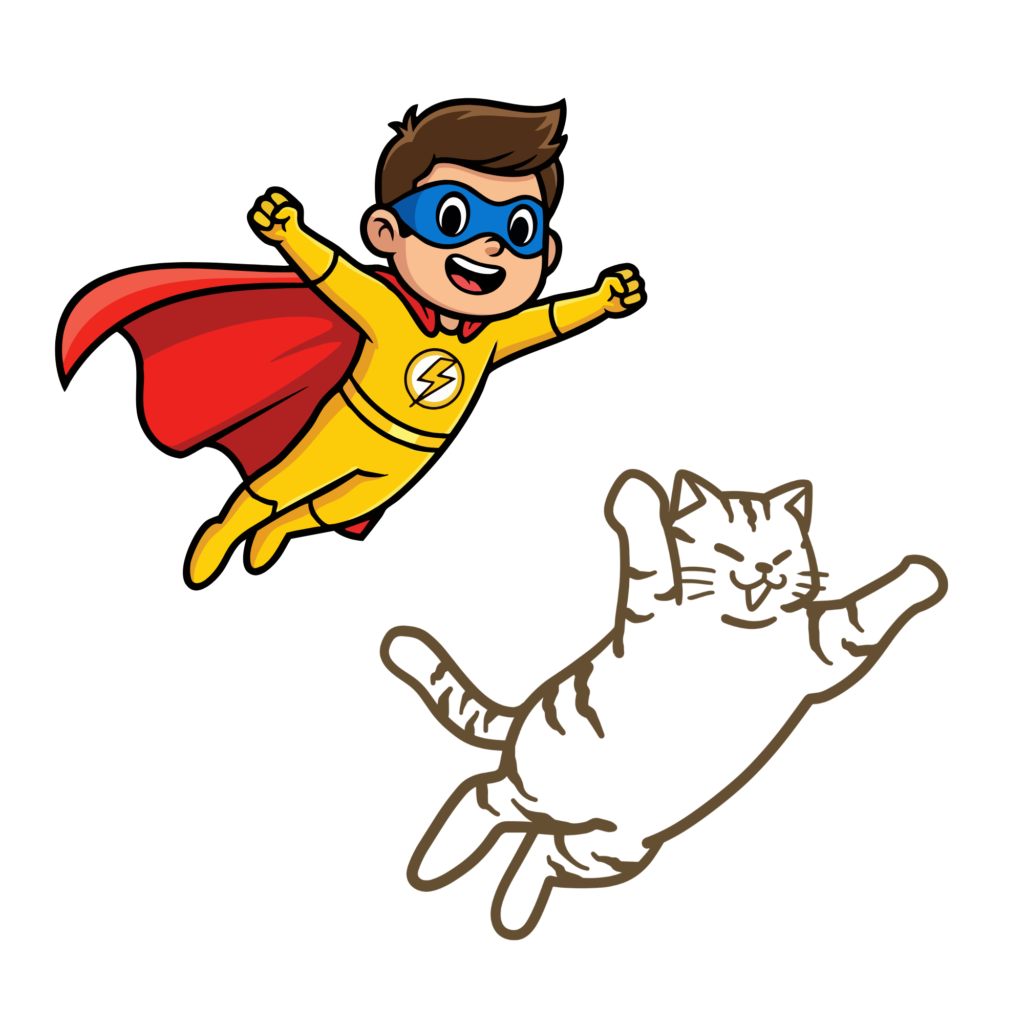
- The movements often have a “bouncy” quality. It gives the impression that the cat is a child pretending to be a superhero. In other words, the “attack” is not “credible”.
- There are feints.
- We make ourselves vulnerable, we self-handicap to give the other a chance.
- There are pauses during which we will try to reassure the other that we are still playing. To do this, we will do one or more of the following behaviors:
- Head turn
- Tongue flick
- Blinking
- Head nod
- Sniffing the ground
- , etc.
- We can also do behaviors in parallel, such as sniffing the ground each on our side during these breaks.
- The claws are not out. There is no injury to the opponent.
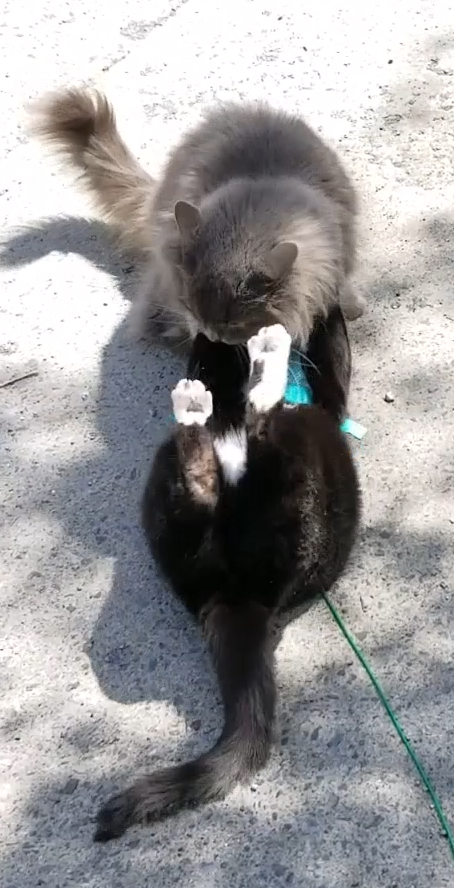
- The “bunny kicks” performed by the hind legs on the opponent when the cat is lying on their side and holding the other cat in their front paws are not harmful.
- We roll on our backs in a relaxed manner to encourage the other to start playing.
- Each is able to turn away from the interaction without being worried about being attacked by the other.
- There is no injury.
- There may be some butt wiggles, similar to when a cat is about to jump on a toy.
- In kittens in particular, we see the “crab walk” where the cat moves sideways, a bit as if their behind is leading them, with a rounded back and a ruffled tail in an inverted U.
Most of these rules are generally also true in dog and cat play.
Cat fights
Typically, conflict involves:
- Quite loud vocalizations.
- Moments of almost total immobility, with bodies tense, with just the nose and tail moving, followed by a lot of very fast attack movements where the two cats are a single indistinct ball and it is difficult to see what is happening.
- There is no pause. The two individuals do not start doing something else, stopping the interaction and then resuming it. They are 100% in the conflict.
- When there is movement in the immobility phase, it is often in extreme slow motion. If one of the cats moves quickly to flee in this context, they would risk getting attacked by the other.
- Both cats will typically use a lot of whining, tension and ultra-slow movement before attacking.
- There is a pursuit on one side only. When there is conflict in a house, it is typically always the same cat running after the other. The one being chased tries to run away and hide out of reach. Other times, the chaser is sometimes in play mode and the chasee is not. While it’s not necessarily a fight, it’s not a game at all if one of the parties doesn’t agree to play.
- There’s usually staring.
- The ears are usually turned back.
- They often try to make themselves look bigger, by arching their back and puffing up their fur.
It’s important to understand that play can become fighting. We want to watch how the other individual responds and how the interaction progresses. This is especially important to distinguish play from conflict because there is a constant evolution as the interaction occurs.
You may have a cat that chatters while playing or a cat that hisses rapidly when irritated. There is variability from individual to individual. Your cat will adapt their vocalizations to what works best with you or with other cats they are around.
Play or fight? Video Examples
The following video illustrates play on the left and fighting on the right. Notice the differences in body tension, types of movements, pauses where interaction is constant, bouncing or stiff movements, etc.
How to react to a cat fight
You’re not sure whether this is play between cats?
Announce that you will be offering cat treats and head towards the treat cupboard.
- If your cats easily disengage from each other, turn towards you, and then follow you, they were probably just playing. Give them a treat.
- If they were just starting a fight, you will have de-escalated the situation.
- If your cats don’t disengage from each other, there is a conflict.
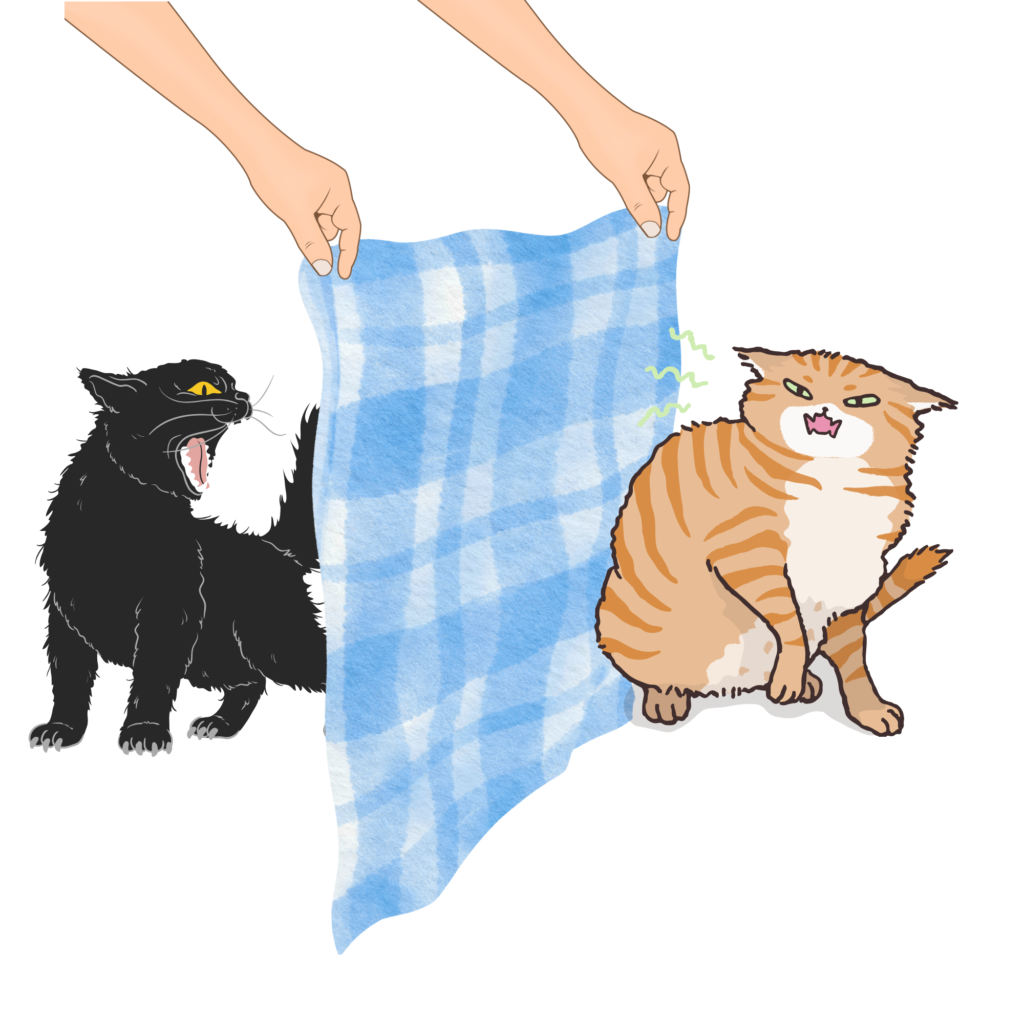
- Use an easily accessible object to visually separate your two cats.
- A throw
- A blanket
- A cushion
- A towel
- etc.
- Simply placing a towel between the two cats usually de-escalates the fight, as they can no longer see each other.
- Use the towel to guide one of the cats into another room and give each of them a treat as soon as they are safely separated.
- “But I don’t want to reward them for fighting!” The treat rewards the action that immediately precedes it. The last thing your cat did was move away from the other cat. THAT’S what we want to reward. We want our cats to know that disengaging from each other will pay off the next time it happens. We also modify their emotional state by offering a positive activity: eating a treat. This helps change each cat’s internal state.
- Use an easily accessible object to visually separate your two cats.
Need more help? Feel free to make an appointment.
Want to learn how to better read feline language? Explore our articles on feline body language.