
How to Choose a Cat Behavior Professional?
by
Cat behavior professionals come in a variety of personalities and special interests. You might “click” with one more than with the other. If you’re unsure whether a professional is a right fit for you, take some time to look at their website and videos. You might find that you relate better to one in particular, and that can be a good place to start.
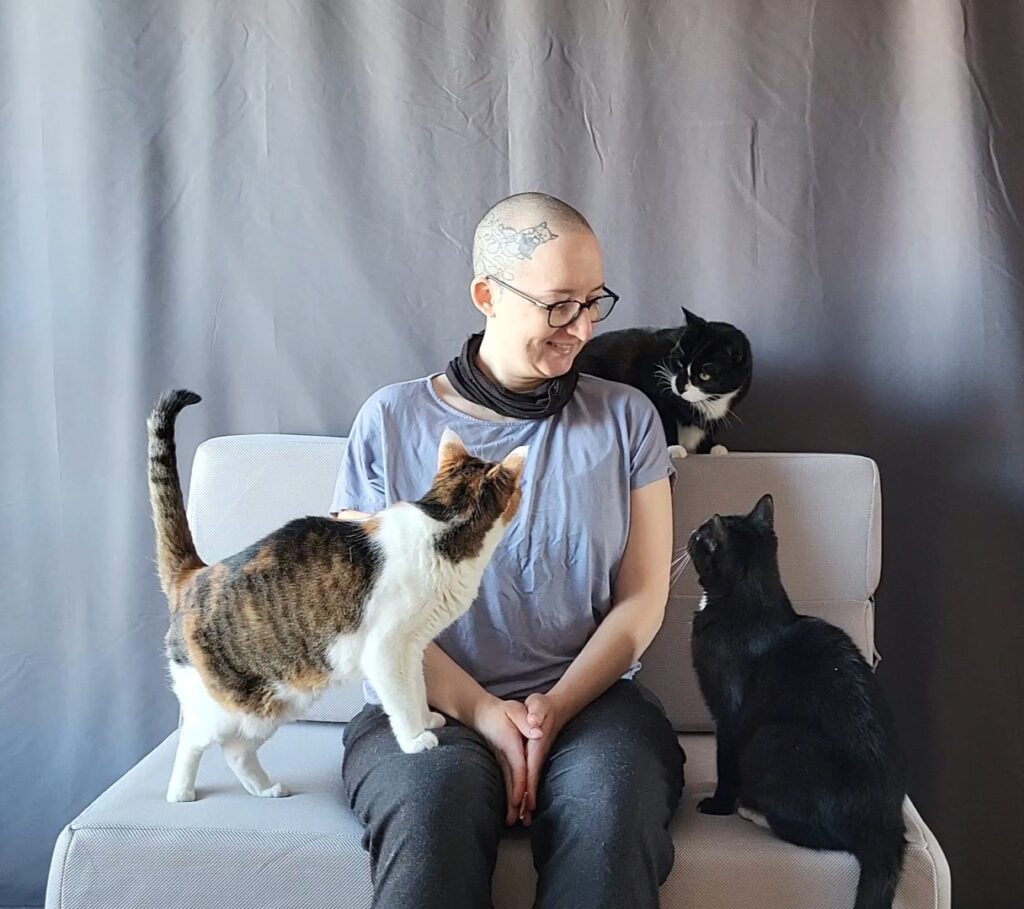
What makes a good cat behavior professional?
Education
Animal behavior is a field that is not regulated, contrary to fields like medicine or engineering. Anyone can call themselves a cat behavior consultant, cat coach, cat therapist, cat trainer, cat whisperer, cat tamer or cat behavior consultant. It doesn’t mean that we can’t be good at what we do. It means it’s a bit harder for the general public to distinguish between competent professionals and people lacking the skills and knowledge required.
Take a look at the About page of the person you’re considering hiring. What education do they have? Which courses did they take? Does their list include many items?
- Have they taken only 2 webinars on cat behavior?
- Or only 1 course?
- Are they providing a list at all?
- Have they presented at conferences? Webinars? While this is not a guarantee of competence, repeated requests to present show that their material and presentation skills were valued.
- Who are their favorite teachers and mentors? Those they look up to? That’s a great opportunity for you to discover other people in the field of animal training and behavior.
- Do they continue to embrace continuing education opportunities? This field is constantly evolving, and new ways of helping cats are emerging. A continued interest in embracing new knowledge shows a commitment to maintaining a high degree of expertise.
Does all their training need to be about cats?
NO! That might surprise you, but a lot of the learning about dogs, farm animals and exotic species also applies to cats! Fields and topics such as:
- Applied Behavior
- Training mechanics
- Stress and its impact on learning
- Case studies: Even when those aren’t about cats. They develop our ability to observe the conditions that trigger a behavior and develop a tailored action plan. Case studies foster creativity. The more case studies we learn from, the better we become at crafting plans for changing behavior.
All these fields teach us crucial information and contribute to us building practical skills that are transferable to a variety of species. It is INCREDIBLY valuable to learn from trainers and behavior consultants who work with species other than cats.
It’s also important to understand that opportunities to learn are more limited if we limit ourselves only to cats. There are a limited number of sources of cat information and of cat courses. When we expand our world, we benefit immensely by getting access to essential and more advanced knowledge.
Keep in mind that research also often applies to species other than the ones studied. For example, rats have taught us a lot about stress responses and training. If we limit ourselves to only cats, we are missing out on a lot of valuable expertise. While education in cats is critical, a wider array of knowledge of skills is even better.
But what about cats?
One field IS specific to cats:
- Ethology
Ethology is the scientific study of the behavior of animals from an evolutionary lens. Ethology is what makes cat professionals competent in… CATS!
- What are cats built to do?
- What behaviors are typical of the species?
- What are cats’ behavioral needs?
- What do cats need to be able to do to feel happy?
- Why do cats do what they do in the way they do it?
- In other words, what make a cat a cat?
For cat behavior, you want a CAT expert.
Dog trainers can have the knowledge and skills from the above fields, but their ethological knowledge is in DOGS, not cats. They will often ask questions in forums because they don’t understand what’s happening with their dog client’s cat. Some dog behavior consultants also do cat behavior consults, just like I also do cat-and-dog consults, but that’s because they have gained the required ethological knowledge related to cats. Just like zoo trainers who work with a variety of species and have learned about and adapted to each species.
Aside from ethology, it is, of course, immensely useful to have trained cats and have taken care of them, because while training techniques are the same, they always have to be adapted to the species, and the individual cat, in front of us.
You can consult the About section to learn more about my professional journey.
Experience
Outside of cat behavior consulting, there are a variety of opportunities to gain firsthand experience in cat behavior:
Sheltering opportunities
- Volunteering at a shelter or rescue
- Shelters can be very stressful for cats. This can promote behavior issues not otherwise seen in homes.
- This is a good opportunity to practice one’s observation skills of behavior and to learn how to interact with shy cats.
- Fostering
- Difficult behavior cases are particularly well suited to fostering. Sometimes, simply getting the cat out of the shelter will do the trick, but if not, it’s an opportunity to train and modify behavior, giving the cat a chance to be adopted.
- This means you can also gain valuable experience with a variety of behavior issues in a short amount of time, as each cat is adopted out within a “short” time frame. You do not have this cat for all their life. You can move on to another cat in need of help.
- Trap-Neuter-Release work and colony care
- Trapping cats for neutering and then releasing them can be very useful in developing one’s observation skills, as free-roaming and feral cats can tend to be more fearful and sometimes difficult to trap.
- Caring for cats from a neutered colony helps one to learn how to interact in a less threatening manner, how to gain trust and presents a huge opportunity to learn about body language and cat-cat interactions.
Veterinary opportunities
- Work in the veterinary field
- While not as useful as one might think, if the work aligns with Low Stress Handling and Fear Free principles, it can provide a huge amount of experience in interacting appropriately with cats.
Personal experience opportunities
- Training your own cats is very valuable. Cat trainers will often have small clips available on social media or full tutorials on YouTube. The more cats one trains, the better one becomes at adapting to each cat’s personality.
- Finally, ones’ own cat behavior struggles are big learning moments. Working with your own cat on a behavior issue is always life transforming. It really helps one to empathize with their clients’ struggles. While we don’t always talk about our own cat behavior journeys, be sure that we have them too. Cats are complex living beings that deserve all the help we can get them.
Special Interests
Each and every one of us has special interests and types of cases that we especially love working on. A consultant’s personal interest can help you decide between two professionals.
Depending on the consultant, their special interests might be:
- Litter box issues
- Aggression towards humans
- Families with kids
- Older cats
- Cats with medical issues
- Excessive meowing
- Destruction
- Cooperative care
- Cat and dog conflict
- Conflict between cats
- Fearful behaviors / Anxiety
- Learning how to train cats, just for the fun of it!
- , etc.
I personally love cases involving fearful cats or conflict between cats, but I am fully qualified to help you with all of the above. People often know me for my cat training videos, but that’s just the tip of the iceberg. Behavior as a whole is a fascinating field and cat behavior issues are the reason I’ve built this business.
Mission and Guidelines
- What values guide the way this professional practices?
- What tools or techniques do they use?
- What code do they follow?
This can help you weed out professionals that don’t align with your personal values. The way we interact with our cats has a huge impact on our relationship and on their well-being.
You can look at our Mission and Guidelines here.
Professional memberships and networks
There are multiple reasons for professional memberships:
- Being a member means you support an organization that has values similar to ours and that works to improve the animal behavior field.
- They encourage exchanges and foster the growth of knowledge.
- They fuel innovation and improvement of best practices.
- They provide access to other professionals to whom one can turn to for support and guidance, as every professional has different practical experiences and expertise. Community is a big part of professional organizations.
The cost of professional memberships can quickly add up and become excessive, which is why a professional might not adhere to many of them. For example, while I support the work of these organizations, I cannot afford to do so by maintaining an annual membership:
- International Association of Animal Behavior Consultants
- Feline Veterinary Medical Association
I am, however, still a member of both of these organizations:
- The Pet Professional Guild
- Fear Free for Pets
Each cat behavior consultant will have their preferred organization to be a part of. It often comes down to the value of the membership and what it offers (community, courses, etc.)
Be Polite When Searching for a Cat Behavior Professional
Please don’t email professionals for free advice. It is not appropriate for you to write a detailed history of your cat’s issues and ask whether we can help. You would not ask this of a health professional, speech therapist, hairdresser or repairman. None of them will do free stuff for you. The same applies to behavior professionals. Value our time, and we will be happy to work with you to our fullest potential.
Still not sure you want to work with me?
That’s OK!
Looking for another Cat Behavior Professional? You might want to take a look at:
- Class Act Cats
- Fellow Creatures Pet Consulting
- The Cognitive Cat
- Beth Adelman
- Educator
- Allison Helps Cats (Allison takes online clients specifically for non-recognition aggression issues)
- Minneapolis, Minnesota
- Portland, Oregan
- Rochester, New York
- New York, New York
- Laval, Quebec
- Lincoln, Nebraska