
Walking Your Cat on a Leash
As the weather is getting warmer and we’re starting to have a bit of greenery outside, maybe you’ll consider trying to walk your cat on a leash. While this was not something that we used to see a lot, it is now much more common to meet someone walking their cats on a leash.
That being said, there are multiple things to think about when starting to walk your cat on a leash.
Why walk your cat on a leash ?
You might not have a garden. You might not have the money to make a catio. But buying a harness and leash is much more affordable, and so that might be an option to explore in order to give your cat more opportunities to explore.
We know that cats spend about 25% of their time roaming, walking and exploring. Unfortunately, we do not always create an environment indoors that allows them to explore every day. Walking outside on the leash can be a very good way to counter that.
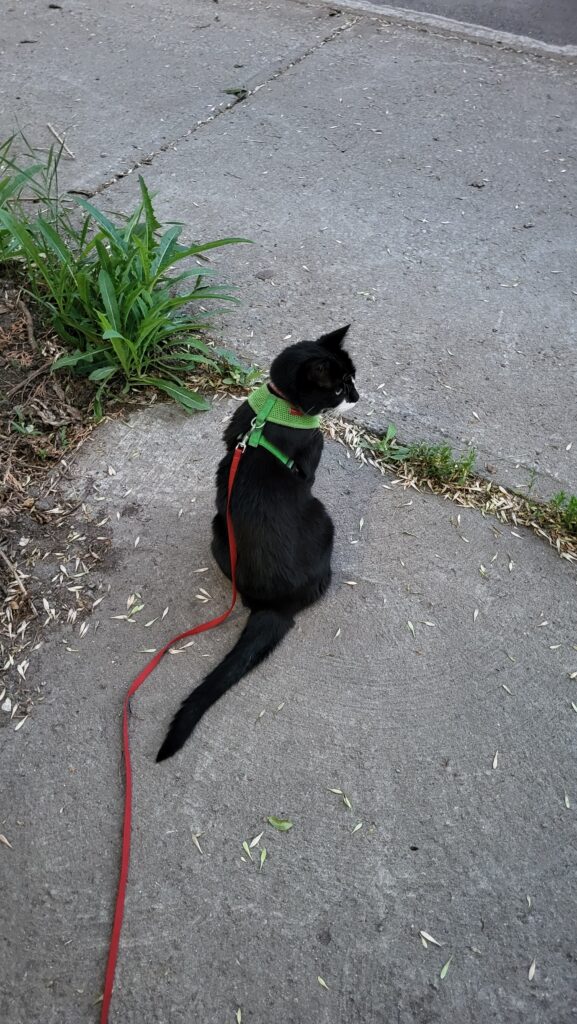
Will my cat be scared to go outside ?
We need to be mindful of the fact that cats are prey species. They are not just predators. They are very much wired to be on high alert and to respond to potential perceived threats by fleeing. Understanding that is the most important thing.
When you start walking your cat on a leash, you’re going to want to start by making sure they can go back home very easily. So your first “walks” might just involve opening the door of the apartment and letting your cat take a look at the hallway. Maybe then they’ll go “Oh, this is too much! I’m going back inside.” You can close the door so that they feel better, but after giving them a couple of seconds, if you open it again, they might decide to try and see again what’s in the corridor. Why? Because they have been reassured that yes, should they feel the need to flee, they will be able to go back inside.
It’s the same thing with a door that leads to the outdoors directly. They might go “Oh! This looks interesting!” and then suddenly, “Oh! It’s a little too much. I’m going to go back inside.”
Always listen to your cat and to what THEY want to do. This is THEIR walk after all. When we know escape is possible, we become much more interested in exploring what’s available. Just give your cat time to learn that the outdoors is fun to explore.
Why don’t people walk their cat on a leash?
Cats are typically not brought up like dogs. We don’t expose them to many different things when they are little and growing up. Not as much as we do with dogs. We don’t bring them in the car to go explore a wonderful park or wonderful trail in the forest. We bring them outside their home and in the car only to go to the scary veterinarian. And so we end up with little animals that have a very limited number of positive experiences with novelty. The variety of experiences that they’ve lived through is not great.
Because of that, cats tend to be more wary of new environments and of new people. We’re not going to take our cats and just go for a walk or bring them into a forest and they’re going to enjoy themselves. That’s not very likely to happen. We need to build their abilities to explore and enjoy being outside by giving them control over their walk. This is accomplished by following them instead of them following us. We will also try to set them up for success so that it’s less stressful for them to start to walk outside.
How to set your cat up for success
Time of day
Most caps will be sleeping around midnight and around noon so the best time to go for a walk is very often in the evening. It’s much easier for most cats to go walking outside when it’s dark than when it’s sunny. When it’s dark, they seem to feel less exposed. Don’t forget that they have much better eyesight in the dark than we do. Evening is the time of day when they’re built to be outside and roaming after prey. That’s a good thing to consider.
You might want to start going outside at 8PM or 9PM, depending on the time of year, because they’re going to be more relaxed at that hour.
Weather
Windy weather is typically way more stressful for cats than if the wind is quiet.
When it’s cold, cats are not really interested in going outside. Bringing them out when it’s cold will just make it more stressful for them. You want a comfortable temperature. Remember that cats are comfortable at temperatures that are higher than the ones we are comfortable at because they are they come from desert species.
Where to start walking your cat?
In a dense urban area, you might start with just the corridor outside your apartment. Then, the staircase might be your next step. It’s likely going to be quiet and you can play games in there, throwing treats. Your cats can chase them up and down the stairs.
Be mindful that elevators are really weird for cats. When they get inside, the doors close, trapping them in there. When the doors open, they’re not in the same place! What’s happening????? A staircase is a better place to start. Very often, there’s no one on the staircase so it’s less stressful for you and your cat.
If you can, start going outside in your backyard. Keep your back door open. It’s probably going to be less stressful for your cat because your garden is likely quieter than the street and, hopefully, full of little insects to chase and vegetation to hide behind. Your cat needs to be enjoying themselves if they are going to want to go outside.
Back alleys are quieter than streets, so that might be your next step. When you open the door to the yard, make sure it’ll stay open so your cat can retreat to it. Initially, when they go into the garden, they’ll need to be able to retreat inside the home. As they start exploring the back alley, they’re going to need to be able to retreat to the garden. The same principle always applies: make sure they have an escape route to their safe space.
Traffic, Runners, Commuters, Mowers, etc.
You’ll want to start at a time of day when there aren’t loads of people around. When people are going to and coming back from work are not good times. The same goes for school hours. You don’t want your cat to freakout because there are people moving about everywhere and kids yelling.
If you live right next to a bar, it might be dark and warm at 9PM, but if there are loads of sounds and people, you might need to go at another time.
Cats will react to loud sounds. So be mindful of mowers, people rolling their recycling bins to the curb, dogs barking when you pass their yard, etc.
Be mindful that picking up a cat that freaks out can result in you getting badly scratched. Try to instead direct your cat sometimes to a bush so they can hide under, behind or inside it. Letting your cat go behind a fence or up a staircase are other options when you want to avoid crossing someone too near. Try to avoid picking your cat up. Getting picked up can heighten their stress levels because they lose control over where they can go. Try keeping your cat on the ground as much as possible.
Dogs
People with dogs are something you need to keep an eye out for. Hopefully, they will be leashed. If not, you can throw treats on the ground or in their face to redirect them to it and give you the time to move away. I often just signal verbally to people that I have a cat from afar and ask them to block the leash if they have a flexi model. People are very nice in general and will be polite.
You should move away from the path of the sidewalk in order to give your cat more distance from the dog: you can go to the entrance of a particular house or go on the street, around parked cars. Depending on whether your cat will follow you or not (that depends a lot on the amount of training you’ve done), you might have to pick your cat up so that you can move them away from the people with dogs.
I have found that, generally, people are really polite and sometimes before I see them, they see me, and they will go around a parked car themselves so that they are not right next to us. This is really, really nice.
Things that move
Things that are not dangerous but that are very scary to cats are another thing to be mindful of. Runners coming towards you are a big trigger for your cat. You want to be mindful of seeing them before they are close to you. Runners are quite fast and you need to react now. Do not wait until your cat freaks out.
Things like skateboards and bicycles can also be a bit scary.
With time, you will notice that there are some things you need to be more careful about for your particular cat. Adapt to their needs.
Does my cat enjoy going for walks?
It’s important to be able to read your cat when out on a walk because they might see things that are more stressful for them than you realize.
In this video, we’ll see cats’ reactions to stressors in their environment. Look at their body language.
- Meloman is stressed by skateboarders in the street.
- Meloman gets excited about birds, but is also fearful of someone that’s coming towards him. You’re going to see him switching from eustress, which is positive stress, to distress, which is negative stress.
- Miley happily explores, but is stressed by a big, loud truck.
You can notice what happens with the tension in the body, the kinds of movements, the belly being lower to the ground, the ears, the eyes, the quality of the movement, etc. If you can notice these things earlier, then you can help your cat make the right decisions more effectively in these situations during your walks.
When escape is possible, and it usually is, it should always be offered.
Walking your cat outdoors can be a wonderful opportunity to share beautiful moments with them. Seeing them explore, be curious and discover things is really fun for me and I hope it can be fun for you too.
If you’d like some help with walking your cat on a leash, book an appointment.